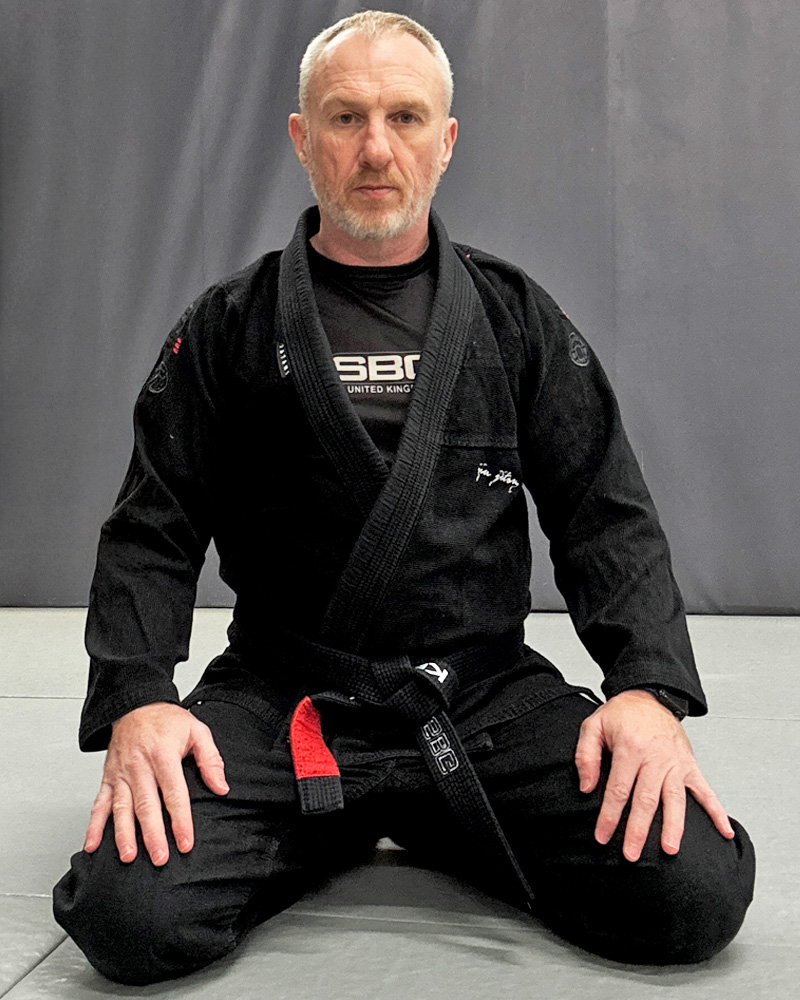
Scrambling is great BJJ when you’re young. When you’re 57, it can become a terrible strategy. I’m not saying older grapplers shouldn’t scramble, because I still do, but somewhere around 50 I realised I had to stop making chaos the foundation of my game. These days, if I’m on top, I want to stay on top, and if I’m underneath, I want to stay safe until the position gives me a genuine reason to move.
That doesn’t mean I’m passive. It just means I’m trying not to waste energy solving problems that don’t actually exist yet. On the bottom, the first things I care about are my frames, inside position, and staying on my side for as long as I can. If we’re just training in the gym, I’m quite happy to stay there for as long as I need to. I don’t feel any pressure to force an escape just because I’m underneath somebody.
Obviously, competition is different. If I’m behind on points, or I need to create something quickly, then I’m going to move faster if I can. But in normal training, I’m prepared to wait. There is a risk to that, because the longer you stay underneath someone, the more opportunities they have to improve their position. So you can’t just lie there and call it patience. You still have to protect inside position, maintain your frames, keep your structure, and stop them progressing.
There’s a big difference, though, between defending intelligently and constantly trying to explode out of everything. I see younger grapplers do that all the time. They feel pressure and immediately they bridge. Sometimes they bridge even when there’s absolutely nothing to bridge. I can be high up across their shoulders and they’ll still throw a massive bridge because somewhere along the line they’ve been taught that if somebody is on top of you, you bridge. The problem is that they haven’t really learned when to bridge, so they end up bridging into thin air.
They spend a huge amount of energy, nothing really changes, and if I’m on top, I’m quite happy with that because they’re doing the work for me. My preferred top position is side control. If I can get there and settle, I want to make the position heavy. I’m not looking to immediately create another scramble. I want good posture, pressure, control, and I want the person underneath me to have to work to improve their position.
Half guard top is probably my second choice because I can still slow things down, control the exchange, and make the other person carry my weight. That’s probably one of the biggest differences between the way I roll now and the way I might have rolled years ago. I’m much more selective about when I explode.
I’m not against explosive movement at all. I still use it, but I want space first. If I feel enough space open up, then yes, I might go hard for three or four seconds. That might be the moment I wrestle up, turn the corner, recover guard, come up on top, or win a scramble. What I don’t want to do is force that moment when the space simply isn’t there, because if there isn’t enough space, exploding usually just means I’ve burned a load of energy and I’m still in the same bad position.
That is probably one of the biggest lessons for me as I’ve got older. I don’t want to spend energy until the position gives me somewhere useful to spend it. When you’re younger, you can often get away with doing the opposite. You move first and figure it out afterwards. You scramble, recover, scramble again, change direction, explode again, and sometimes sheer athleticism fixes the mistakes.
At 57, I don’t want to rely on that. If I have one really hard scramble in an exchange, I want that scramble to matter. I want it to end with me somewhere better, and once I get there, I want to shut the scramble down. I think that’s the part a lot of older grapplers miss.
People sometimes talk about BJJ after 40 as though the answer is simply to slow down, but I don’t think that’s quite right. I still want to move fast when I need to, and I still want to be explosive when there’s an opportunity. What I don’t want is unnecessary movement. There’s a difference. Slower isn’t necessarily better. More selective is better.
If I’m safe underneath, I don’t need to panic just because I’m on bottom. If I’m controlling somebody from side control, I don’t need to rush into a submission and give them the space they’re looking for. If there isn’t enough space for an escape, I don’t need to force one. And if the younger guy underneath me wants to bridge ten times into nothing, I’m quite happy to let him, because eventually one of those movements might actually create the opening I want.
So when I say scrambling is a young man’s BJJ, I’m not saying older grapplers shouldn’t scramble. I’m saying I don’t think your game should depend on it. At 57, my BJJ is much more about controlling the exchange, staying safe underneath, getting on top when the opportunity comes, staying on top once I get there, and only spending energy when the position actually gives me something back.
I’ll still scramble. I just want to know what I’m scrambling for.