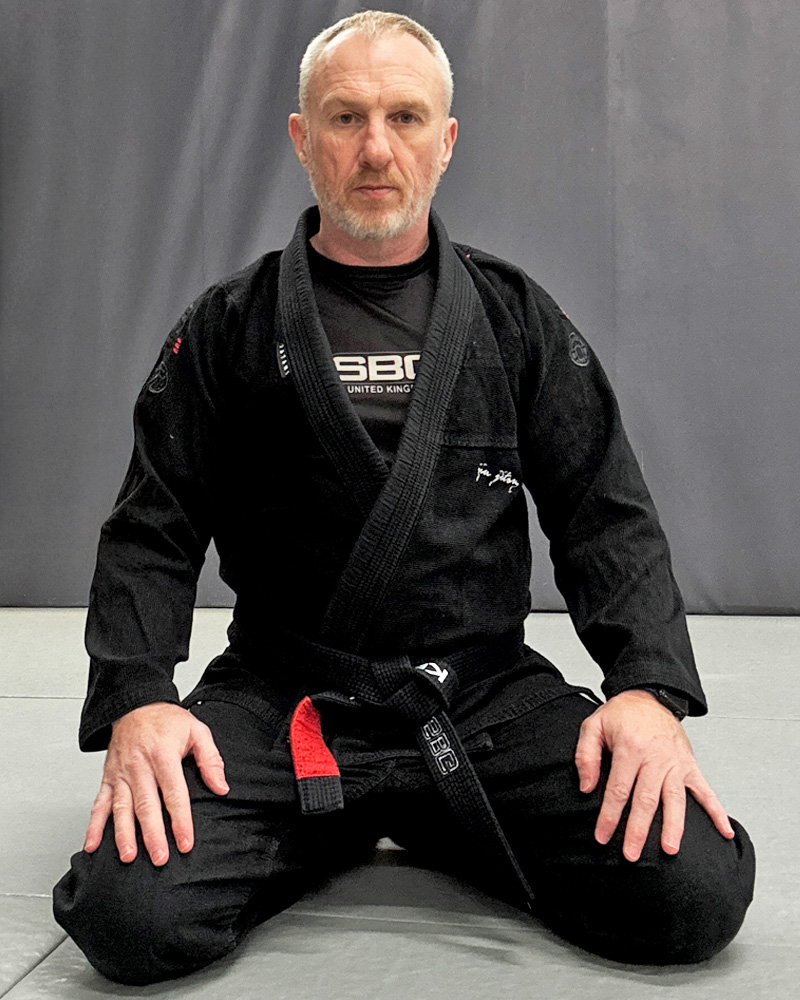
There’s something about Brazilian Jiu-Jitsu that makes it very difficult to leave your ego behind, regardless of how long you’ve been training or what belt you’re wearing. We all like to think that as we get older, we become wiser, more patient and less concerned about what other people think of us. And to some extent, that’s true. But I’ve been training long enough to know that ego doesn’t simply disappear because you’ve reached a certain age or earned a black belt.
In fact, sometimes the pressure to prove yourself becomes even greater.
When you’re a white belt, nobody really expects you to know very much. You’re learning, making mistakes and trying to survive. But as you progress through the ranks, particularly when you reach black belt, those expectations change. You’re supposed to understand jiu-jitsu, you’re supposed to have answers, and you’re supposed to be capable of dealing with whatever the person in front of you brings to the mat.
Add age into the equation, and things become even more complicated. You’re no longer just trying to demonstrate your jiu-jitsu. You’re sometimes trying to prove that you can still do it, that you’re still capable, and that the years haven’t taken away the abilities you’ve spent so long developing.
But at what point does that desire to prove yourself become counterproductive?
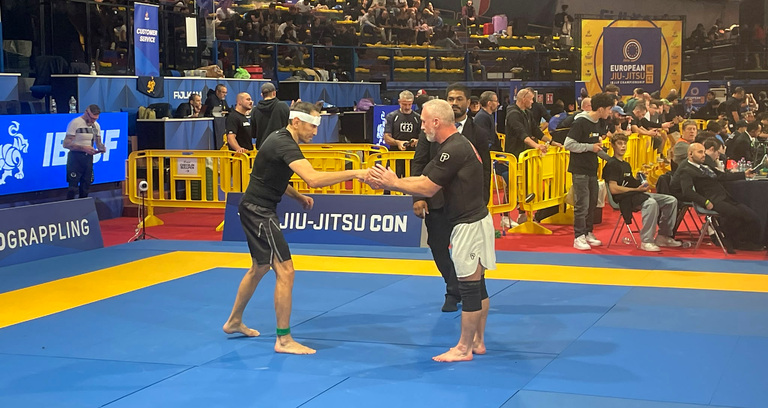
It’s something I’ve been thinking about quite a lot recently, particularly after competing at the IBJJF No-Gi European Championships in Rome.
Competition: What Does Winning Actually Prove?
When I started thinking about writing this article, I was preparing to compete at the European Championships. Several of our students had already won gold medals, including one who took double gold in the adult blue belt ultra-heavyweight and open-weight divisions, and there was naturally a little pressure on me and another of our coaches to deliver something similar.
Of course I wanted to win. I’d spent months preparing, dropping weight to compete at lightweight, and getting myself ready to face other black belts. Nobody goes through that process hoping to lose, and I’m certainly no different.
Well, the competition has now finished, and I came home with two medals. I won gold in the lightweight division at 73.5kg and bronze in the open weight. At 58 years old, I’m now a No-Gi European Champion at black belt, which is something I’m obviously pleased about.
But here’s the interesting thing. It doesn’t actually mean that much to me.
Don’t misunderstand that. I’m proud of what I’ve achieved, and I’m glad I competed. But I genuinely believe I would have been happy regardless of the result. I’m not saying I wouldn’t have been disappointed if I’d lost, because of course I would. We all want to win. But the result itself doesn’t seem to carry the same emotional importance that it might have done when I was younger.
My lightweight division was an unusual experience. I won my first match in around a minute with a Japanese necktie, which was obviously a satisfying way to start. In the final, however, things took a rather unexpected turn.
During a standing exchange, I used a heavy collar tie against my opponent. It was a legal technique, but he clearly didn’t appreciate it and responded by slapping me across the face. The referee stopped the match, consulted another official, and my opponent was disqualified.
I would have happily continued the match, and if I’m being truthful, I would have preferred to win under different circumstances. A disqualification wasn’t how I’d imagined becoming European Champion, but the decision wasn’t mine to make. The officials applied the rules, and I was awarded the gold medal.
I also entered the open-weight division, where I was giving away a considerable amount of weight to the other competitors. There were four of us in the bracket, including middle-heavyweight, super-heavyweight and ultra-heavyweight competitors. I drew the middle-heavyweight in my first match.
He managed to take me down and score two points, which wasn’t something I’d expected. I then spent much of the match underneath him, alternating between closed guard, half guard and lockdown while trying to create opportunities to sweep or attack.
At one point, I secured a tight guillotine from half guard, but I couldn’t get far enough onto my side to finish it. He was heavy, controlled his position well, and I struggled to get underneath him effectively enough to sweep or get back to my feet. With around a minute remaining, I opened my guard to try to make something happen, but he capitalised on the opportunity, passed and scored another three points.
I lost the match on points, and he was a good opponent who deserved the win.
I came away with bronze in the open weight, but there was no great sense of disappointment about losing that match. I had tested myself against a larger, capable black belt, had some opportunities, made some mistakes and ultimately got beaten. That’s competition.
What I find interesting is how little these results have changed the way I feel about myself.
Winning gold hasn’t suddenly made me a better coach or given me some new understanding of jiu-jitsu. Equally, losing in the open weight hasn’t diminished my ability or erased the knowledge I’ve accumulated over the years.
I’m still the same person who stepped onto the mats before the competition. I have the same strengths, the same weaknesses, the same injuries and the same things I need to work on.
And perhaps that’s something we should think about more as we get older.
There’s absolutely nothing wrong with wanting to win. I still want to win, and if I compete again, I’ll approach it with exactly the same ambition. But I don’t want my sense of achievement or self-worth to depend on whether a referee raises my hand at the end of a match.
At this stage of my life, being able to prepare for a major competition, travel abroad, step onto the mats and test myself against other black belts is something I value in its own right.
The gold medal is a bonus. The opportunity to keep doing this is what really matters.
The Pressure of Being a Black Belt
Becoming a black belt doesn’t mean you’ve mastered jiu-jitsu. It means you’ve reached a level of understanding and experience, but there’s still an enormous amount to learn.
I think sometimes people forget that.
There’s a tendency to put black belts on a pedestal, as though we’re supposed to know everything. And when you’re coaching, that expectation becomes even more noticeable.
I’ve had situations where other coaches or peers have challenged my approach because they believe their way is better. I’ve also had students question things I’m teaching because they’ve watched something different on YouTube or seen an instructional from a well-known competitor.
Now, I don’t have a problem with people asking questions. In fact, I encourage it. If something doesn’t make sense, I want students to understand why we’re doing it rather than blindly accepting it because a black belt said so.
But there’s a difference between asking questions to learn and questioning somebody because you assume you’ve found a better answer online.
Jiu-jitsu is full of different approaches, and what works brilliantly for one person might be completely unsuitable for another. A technique demonstrated by an elite competitor may be excellent, but that doesn’t automatically make it the best option for a recreational grappler in his fifties with limited flexibility and a history of injuries.
I also recognise my own limitations as a coach.
I’m never going to be John Danaher or Marcelo Garcia, and I don’t feel the need to pretend otherwise. They’ve devoted their lives to developing an extraordinary depth of knowledge and ability, and I respect that enormously.
But that doesn’t mean I have nothing valuable to teach.
I’ve been involved in martial arts for decades. I’ve trained, competed, coached and dealt with the physical consequences of doing all of those things for a long time. My understanding comes from that experience, and particularly from learning what works when your body doesn’t always cooperate.
I believe that has value.
What I don’t want is to feel that every class I teach or every round I roll has to become some sort of demonstration that I deserve my belt.
Because that would be exhausting, and ultimately it would undermine the very reason I still train.
Are We Losing the Fighting Art in Jiu-Jitsu?
There’s another aspect of modern BJJ that I think deserves more discussion, and that’s how far the sport has moved away from its fighting origins.
I enjoy sport jiu-jitsu. I compete in it, coach it and appreciate the technical sophistication of modern grappling. Some of the developments we’ve seen over the years have been extraordinary.
But I don’t believe being good at sport jiu-jitsu automatically means you’re good at fighting.
Those are two different things.
You can become extremely skilled at passing guards, playing complicated leg entanglements, inverting and winning exchanges under a particular ruleset without ever having to deal with someone trying to punch you in the face.
That doesn’t make those skills worthless. Far from it. But it does mean there can be significant gaps between what works in a grappling competition and what works when strikes are involved.
For me, Brazilian Jiu-Jitsu should never completely lose that connection to fighting.
I believe every BJJ academy should teach at least some striking awareness, both standing and on the ground. Students should understand how punches change positions, why distance management becomes so important, how to defend strikes, and how to close distance safely and take somebody down.
I’m not suggesting everyone needs to become an MMA fighter or spend their evenings getting punched in the head. There are sensible, controlled ways to teach these skills without turning every class into a fight.
But if we’re teaching people an art that developed around controlling and submitting an opponent, I think we have a responsibility to explain how those skills function when the other person isn’t following the rules of a grappling competition.
For me, that’s part of remaining capable.
I don’t just want to be able to perform jiu-jitsu against somebody who agrees to play jiu-jitsu with me. I want to maintain an understanding of how to protect myself in a more unpredictable situation.
And I think that should matter regardless of whether you’re 25 or 65.
When Ego Meets the Wrong Training Partner
One of the more painful lessons I’ve learned over the years is that not everybody who steps onto the mat has the same understanding of what training should be.
This becomes particularly noticeable when visitors arrive at the gym.
Most visitors are absolutely fine. They come to train, learn something, experience a different environment and enjoy some good rounds. But occasionally you encounter someone who seems more interested in proving themselves against the people who train or coach there.
I remember one visiting blue belt who came into the gym and wanted to roll with me. Before we started, I explicitly asked him to keep things relaxed and technical.
He agreed, but once the round started, that understanding seemed to disappear.
He went at me with far more intensity than we’d agreed, including trying to catch me in a heel hook. It wasn’t the controlled, technical round I’d asked for, and I wasn’t prepared to tolerate it.
I ended the situation and told him to leave the mat. He never returned.
Now, some people might interpret that as a black belt whose ego couldn’t handle being challenged by a blue belt. But that’s not how I see it.
There’s nothing wrong with a blue belt catching a black belt in a submission. It happens, and it should happen in a healthy training environment where people are learning and experimenting.
The problem wasn’t that he was trying to submit me. The problem was that we’d agreed on how we were going to train, and he ignored that agreement.
At 58, with the injuries and physical issues I’ve accumulated over the years, I’m not prepared to gamble my health just because somebody wants to test themselves against a black belt.
And frankly, I don’t think anyone should have to.
The difficult part is recognising when your own ego is encouraging you to accept a round that you would otherwise avoid. I’ve certainly been guilty of that over the years. Sometimes you don’t want to appear unwilling, and sometimes you simply want to demonstrate that you can still handle the younger, stronger and more aggressive people in the room.
But what are you actually gaining?
If you win the round, perhaps you get a few moments of satisfaction. If something goes wrong, you could be dealing with the consequences for months.
That’s a terrible exchange.
I still enjoy challenging rounds, and I don’t want to train in an environment where everybody is afraid of applying pressure. But there’s a clear difference between somebody who rolls hard with control and somebody who has no consideration for your safety.
Learning to recognise that difference, and being comfortable saying no, is one of the most valuable skills I’ve developed.
What Does Being Capable Actually Mean?
This brings me back to the question I’ve been asking myself: what am I still trying to prove?
I don’t feel a great need to prove myself through competition anymore, although I certainly still want to win. I do care about being a good coach, and I want people to feel that what I’m teaching has value.
But perhaps more than anything, I want to know that I’m still capable.
I want to be able to train with younger people, defend myself, apply my jiu-jitsu and demonstrate that the knowledge I’ve accumulated over the years still works.
I don’t think there’s anything wrong with that desire.
In fact, I think maintaining physical capability is one of the most important things we can do as we age.
But there’s a distinction between wanting to remain capable and constantly feeling the need to prove it.
The first encourages you to train, learn, improve your fitness, manage your body and develop your skills. The second can encourage you to ignore warning signs, accept unnecessary risks and turn ordinary training sessions into competitions that nobody else particularly cares about.
If somebody asked me whether I’d rather be able to beat a young blue belt today or still be training and coaching when I’m 67, ideally I’d like both.
But if I genuinely had to choose, I’d choose the latter without hesitation.
And I think that tells me everything I need to know about where my priorities should be.
The Real Measure of Success After 40
There was a time when progress in jiu-jitsu was relatively easy to measure. You learned techniques, started catching people, earned belts, entered competitions and hopefully collected a few medals along the way.
Those things still matter, but I don’t believe they tell the whole story.
As we get older, progress can take different forms. It might be developing a game that no longer relies on explosiveness or flexibility. It might be learning how to control a stronger opponent without exhausting yourself. It might be recovering better between sessions or becoming more confident in your ability to handle pressure.
It might even be recognising that a particular round isn’t worth taking.
None of those things will get you a medal, but they might allow you to continue training for another ten or twenty years.
That doesn’t mean abandoning ambition. I’m certainly not planning to stop competing, coaching or trying to improve. I still want to challenge myself, and I still believe that some of my best understanding of jiu-jitsu may be ahead of me.
But I’m increasingly aware that there’s a price attached to every decision we make on the mat.
We have to decide which challenges are worth accepting and which ones are simply feeding our ego.
We have to recognise that being a black belt doesn’t mean having all the answers, that losing a competition doesn’t erase years of experience, and that being capable doesn’t require us to prove it to everyone who walks through the gym door.
I recently came home from Rome with a European gold medal and an open-weight bronze. I’m pleased with both, and I’m proud that I was able to compete. But those medals haven’t changed my understanding of what really matters.
I’ll still be a black belt when I lose. I’ll still have the same knowledge when somebody younger gets the better of me. I’ll still have things to learn, weaknesses to improve and physical limitations to manage.
And hopefully, ten years from now, I’ll still be stepping onto the mats, still coaching, still learning and still finding ways to improve.
Because when I think about what I really want from jiu-jitsu at this stage of my life, that’s what matters most.
I don’t want to spend the next ten years proving that I’m still capable if doing so costs me the opportunity to remain capable for the ten years after that.